
A Beginner’s Guide to Blockchain Technology
Meta description: Learn blockchain explained in plain English. An easy-to-understand, illustrated introduction to blockchain that includes a brief test, use cases, advantages, and an explanation of how it operates.
Blockchain is a digital ledger—like a shared spreadsheet—duplicated across many computers so everyone can see the same record and no one can secretly change it.

Features
Immutable: Once a block is added, it cannot be altered without everyone’s knowledge. Decentralized: The ledger is not controlled by a single individual, business, or server. Transparent: Transactions are visible to anyone with access to the network. Secure: Consensus and cryptography make manipulation very challenging.

Plain-language analogy
Imagine a public Google Sheet that records transactions. Every time someone adds a row, the sheet is duplicated to thousands of computers. Before a new row gets accepted, many of those computers check that the new row is valid. That row is permanently locked once it is accepted. That’s blockchain in a nutshell.
How blockchain works — step by step
- Someone creates a transaction (Alice sends 1 coin to Bob).
- The network of nodes (computers) receives a broadcast of the transaction.
- Nodes verify the transaction (valid signatures, sufficient balance).
- Verified transactions are grouped into a block.
- To accept the block, the network comes to a consensus (e.g., proof of work or proof of stake).
- The block is appended to the chain—the ledger is updated across the network.
- The transaction is final (after a few more blocks confirm it).
Tip: “Final” usually means waiting for a few more blocks so the network can’t reorg those transactions.

A short note on consensus
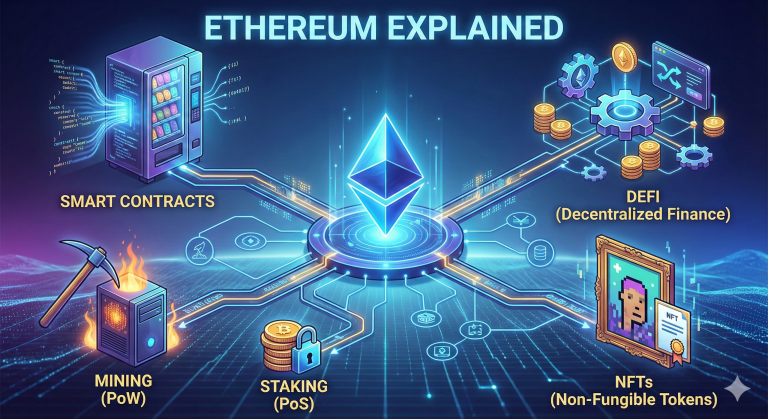
- Proof of Work (PoW): Computers solve hard puzzles to add blocks (energy-heavy).
- Proof of Stake (PoS): To obtain the authority to add blocks, validators lock up coins (energy-efficient). (You don’t need to memorize these—just know they’re the systems that help nodes agree.)
Common use cases
- Payments: Fast cross-border transfers without banks.
- Supply chain tracking: Verify origin and movement of goods.
- Gaming & NFTs: Prove ownership of digital items.
- Identity verification: Secure, tamper-proof identity records.
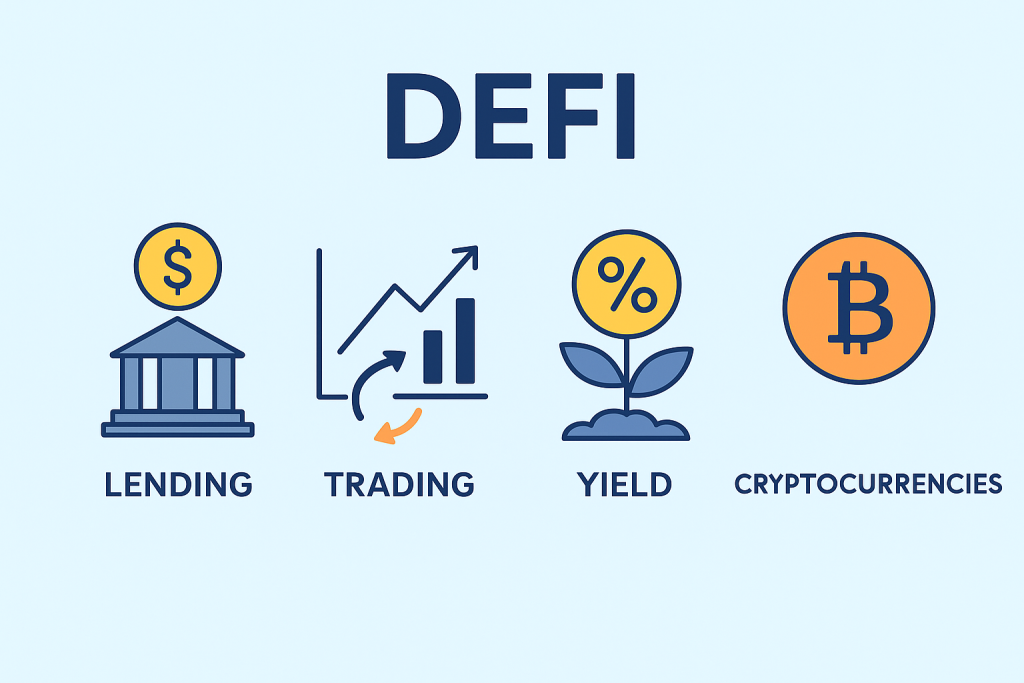
- Decentralized finance, or DeFi, is trading, lending, and yielding without the use of banks.
Benefits and Limitations
Benefits
- Censorship-resistant transactions
- Improved openness and traceability.
- Reduces intermediaries.
Limitations
- Scalability (some blockchains are slow and expensive)
- Some sorts of consensus are concerned with energy and the environment.
- Usability: wallets and keys can be confusing for newcomers.
Quiz
- “Ready for Day 3? Tomorrow we’re dropping: How Crypto Wallets Work & How to Create Your First Secure Wallet — stay tuned!”